This post was written in paid partnership with Squarespace. All views and experiences are my own.
A week in New York, built around Circle Day
For the third year running, I built a week in New York around Circle Day. The first year I attended as a regular attendee. Last year I was invited to lead two breakout sessions on growing your own team. This year I was invited to offer brand consultations to three conference attendees who signed up in advance. The conference at Squarespace HQ was in the middle of the week, and around it I met with clients in person, both active projects and projects we completed in the last year or two.
The week opened on Tuesday with a law practice client who is developing her personal brand alongside her firm. Meeting in person gave me a much better feel for who she is. You get the small stories that make a brand feel like the person and not like a firm. There are so many considerations that go into how someone presents themselves online. They want to align with the type of clients they would like to work with, their ideal client, and they also want to align internally, so that what they put out is true to their values and clear about who they are becoming as they bring their presence online and promote their services or brand. That kind of strategy, and the compromises that come with it, only surface in a long conversation.
This is why I now go every year. For our client process, for referrals, for the quality of the work, and to make the connection personal, these meetings have become the most valuable week in my calendar.
Trading coffee for Rothko
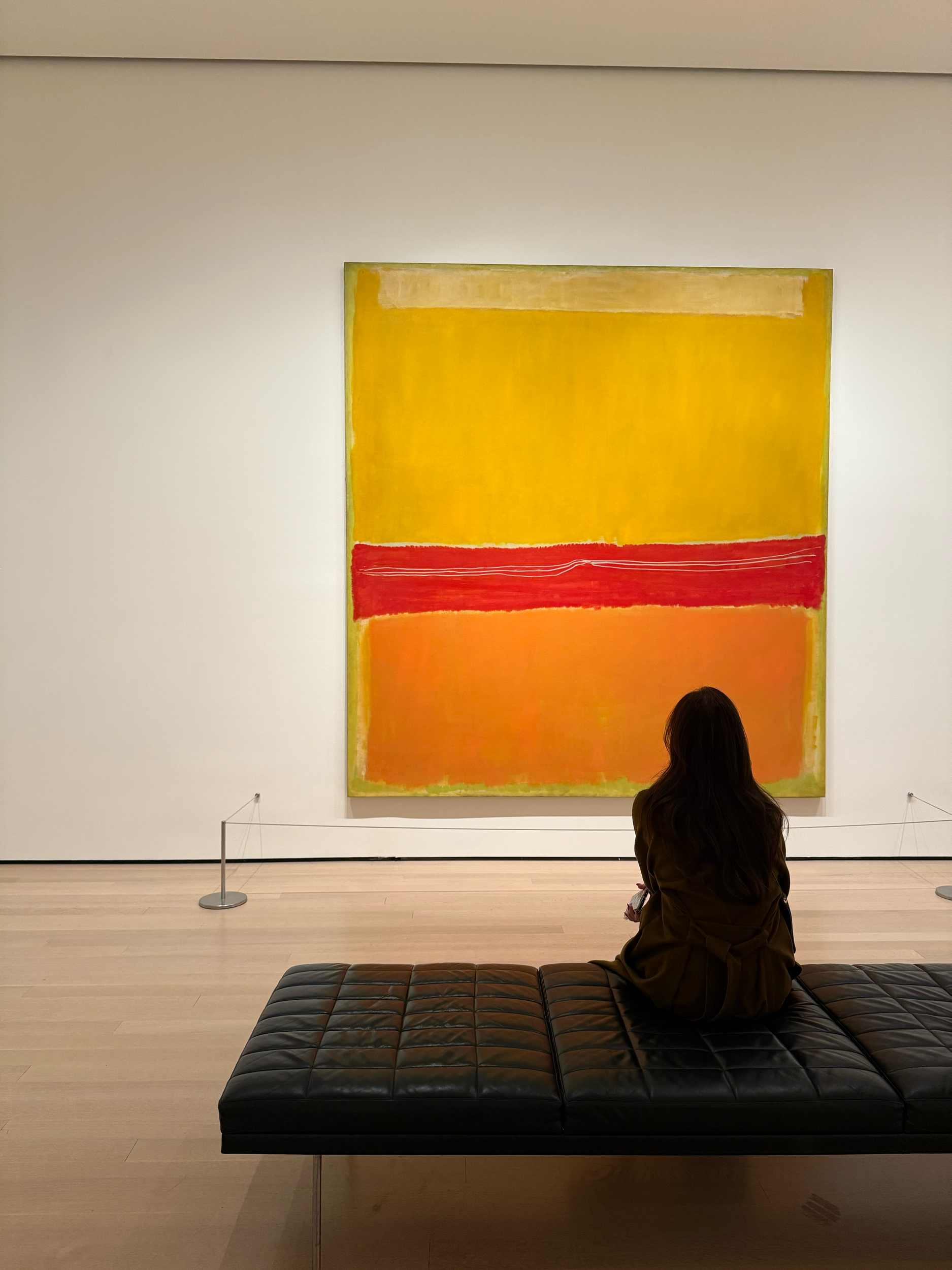
This year I also changed how the meetings themselves happened. Instead of sitting across a table in a coffee shop, I suggested to a few clients that we pick an exhibition at one of the big New York museums and see it together. Over the week that took me to the Met, the Guggenheim, MoMA and the Whitney. We still talked about the work, but standing in front of a painting the conversation drifts somewhere a zoom call never allows. We talked about taste and color, about abstraction versus storytelling, about what moves us and why, and about where each of us has come from. You learn so much about a person in an hour of looking at art together, and that understanding goes straight back into how I design for them.
There is a tension in all of this that I kept noticing during the week. Work is accelerating toward the automated and the remote, and at the same time we get to decide what we do with the time that frees up. I chose to spend it in person, making connections and getting creative. Getting our time back is, I think, going to be one of the greatest opportunities AI gives us. It clears brain space and capacity, and that is what enables creativity. But we have to be very intentional about how we use that time, whether it goes to our business, to creative pursuits, to parenting, or to the other things that make us human and better people.
The evening before the conference
On Tuesday night Squarespace hosted a dinner at Roey’s, a small Italian restaurant, and from the moment I walked in it felt cozy and inviting, more like a dinner at a friend’s house than a company event. There were familiar faces everywhere. I was seated with members of the Squarespace team, with Puno, who would host Circle Day the next morning, and with Becca Harpain, Michae Brodzik and other community leaders and educators who have shaped a community I feel so lucky to be part of. I still remember the day I signed up for Squarespace Marketplace when the program opened in 2018, starting from scratch and learning everything as I went. It is incredible to think back on that and then find myself at a table on a Tuesday night in New York, sitting across from the very people whose YouTube tutorials got me through those first months when I did not know what I was doing. To say this community changed my life is an understatement. The people I have met and the projects I have worked on because of it have been more than I could have imagined back then.
Not just a circle, a hug
There is something special about being welcomed into Circle Day. The Squarespace headquarters, the staff, the speakers and the attendees all share the same openness, a real wish to learn from each other and to give something back. It feels like a creative community in the truest sense, and I think the reason is simple. Most of us spend thousands of hours a year working alone behind a screen. Once a year we get to be in one room with people who do exactly what we do, and that is harder to describe than it sounds. Puno, who hosted the day, said it best: Circle is not just a circle, it’s a hug.
The welcome is generous, the merch is always on point, and the day runs so smoothly from start to finish. It is obvious how much Squarespace cares about their creative community. The effort and planning that go into one annual meeting are impressive to witness, and I am glad to be part of a company that treats the creatives orbiting its products as a valuable part of the ecosystem, listens to our feedback and keeps inviting us back.
What my clients love about Squarespace, and what’s new for them
After eight years and hundreds of websites, and having worked with other platforms, I know what makes clients happy with Squarespace. No intimidating back end. Hosting and security are handled. We are not charging them a monthly fee to keep the site from breaking, and there are no plugin updates. They can change the text and images themselves. Most of our clients came from a platform they dreaded logging into, and their websites were getting neglected, even at fairly large companies. The announcements this year strengthen exactly that promise. Drafts with autosave and version history, so a client can edit without fear. Image Studio, with a Reshoot option for client photos. And vertical video in the video block, which will make a lot of my clients happy.
I will be honest about one thing. I am not yet convinced about widespread use of AI-generated imagery on websites. As a placeholder to get a site launched, fine. If you are trying to build a trust-based relationship with a client, I think AI imagery removes an element of trust. It can read as if you did not care enough to do a photo shoot or select the right pictures. I am like that as a consumer myself. I would not buy from a company whose site is only AI images presented as real people and real places. Nobody likes to be deceived. If the imagery is clearly AI and that is part of the creative idea, why not. But the eye is getting trained to recognize these images. Poorly executed AI imagery can damage a business more than it helps, and more broadly it is pushing us toward a more uniform visual world. AI image creation is a service we offer, it has come in handy many times, and it is good that Squarespace offers it. I just always think about how it will be used in practice.
The new business tools announced this year (SMS Campaigns stuck in my brain) will matter a great deal to e-commerce businesses, and I do not do a lot of e-commerce, so it is not my place to speak on them. My clients are not the most marketing-oriented people, simply because of their profile. We always want best practices in place, but for them it is less about the highest conversion rate or how many inquiries come in per week, and more about confirmation. Their visitors already want to work with them, whether that is a doctor, a dermatologist, an interior designer or a photographer. They are basically ready to book. What they need from the website is confirmation that this person is indeed who they appear to be, that they are professional, and that they take care of their own online presence and invest in it. The way you do one thing is the way you do everything. That is why so much care goes into each site. My clients want websites that are beautiful, that function well, that are fun to interact with, and that do not make you exhale a sigh of frustration every time you need to change something on the back end. Squarespace achieves exactly that.
Brand consultations
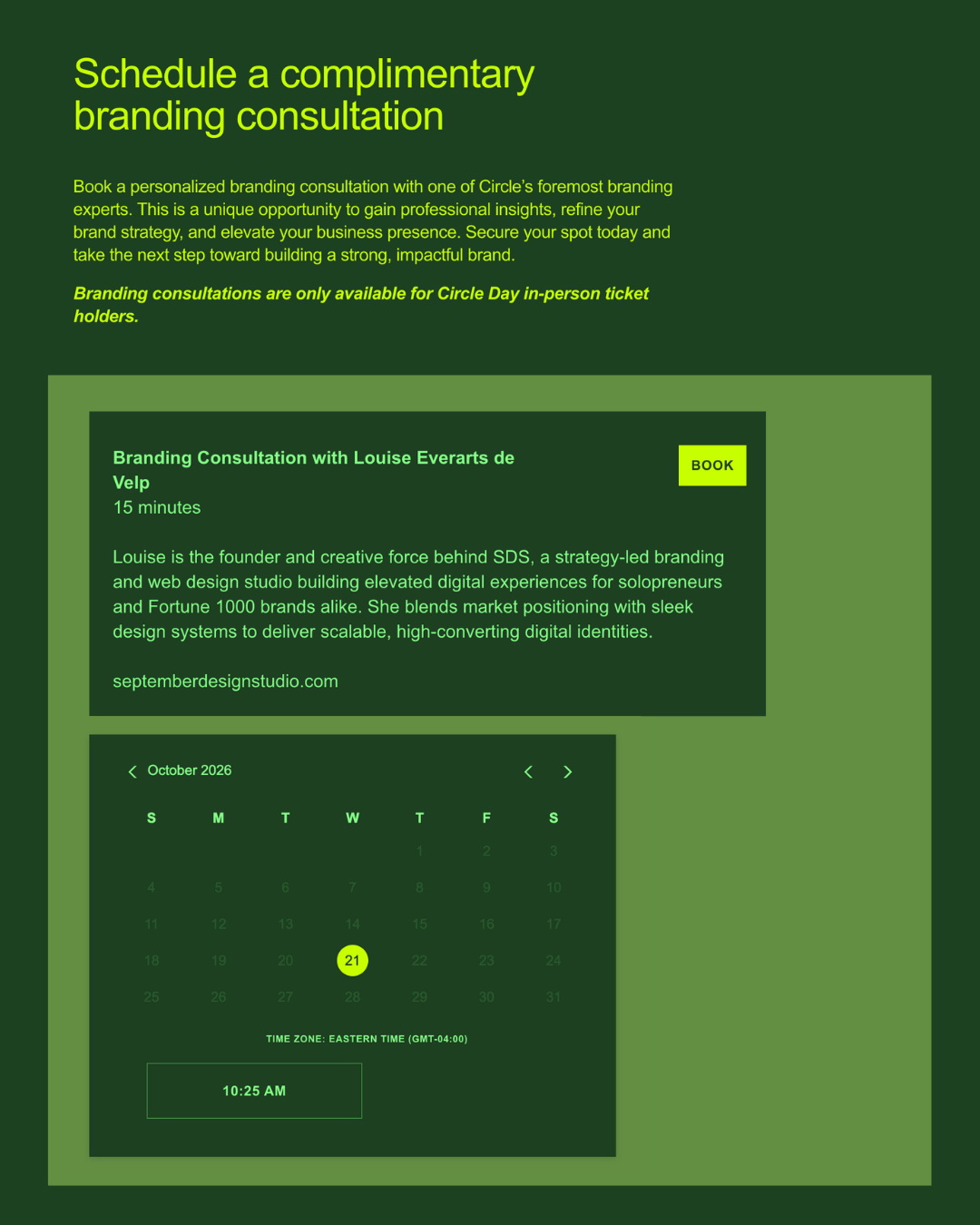
Alongside the programme I gave two 15-minute brand consultations. The first was with Lo of Scene by Lo, a designer based between Atlanta and Philadelphia whose work spans business branding, operational design and event stationery. She had just left her full-time job to go all in on her own studio, had landed her largest client the week before, and told me she had been undercharging for a long time without knowing how to position herself. She has loved paper, journals and handwriting since she was a child, and it shows in her stationery work, so my first suggestion was to turn her own handwriting into a font and make it part of her brand identity. Something that only she can produce becomes something no template can imitate. The rest of our conversation was about positioning. In a time when anyone can generate a logo in minutes, the handmade and the considered become the premium offer, and the way to charge for them is to act like the expert you are. That means presenting one concept, the one you believe in, rather than three for the client to choose between. It means being the person clients come to for design judgment, not the person who takes orders. A designer who trusts her own expertise gives her clients permission to trust it too, and the pricing follows from there.
The second consultation was with Josué of dply, a bilingual marketing strategist based in Mexico City. His agency runs on a method he calls push-n-pull, social ads to build familiarity and search ads to capture buyers who are ready to act, and he builds his clients’ websites on Squarespace. He did not need direction. He already knows who he wants to be, he is putting in the hours, producing the materials and connecting with the right people, and what he needed was a sounding board, someone outside his own head to confirm that the direction holds. Fifteen minutes is not long, but it was enough to see what the two sessions had in common, and it is what I see in most of my own clients. Neither of them had a design problem. Both already knew who they were. What they needed was to hear it said back to them clearly, and permission to show up as that person with confidence, in their pricing, in their presentation and in how they talk about their work
Forma, and the right project to try it on
As for Forma, the Squarespace team described it as a way to build, run and connect like never before, and that is the promise. I received early access this week and I have joined the community for it, but I have not yet found the right project to test it on. There is so much it can do that I want a really good idea before I start, so that I am not thinking of it as starting another website but asking how I work with a completely new tool that can, in a way, do almost anything. The opportunity I see is in business automation and integration combined with a very cohesive look and feel: a high-touch, customized experience for the visitor that is at the same time much simpler for the small business owner, so they can focus on their business. The right clients for it exist. I do have two open questions. One is what happens to clients who are not very tech forward and may still prefer 7.1? The other is about designers, who are fundamentally visual people, now expressing themselves through words and a chat interface instead of the blocks and raw material that make Squarespace so unique to build with. I am curious to see whether creatives enjoy working this way, and whether clients find the back end approachable or intimidating.
Thank you
Thank you to the Squarespace and Circle teams for another year, and to my own team at September Design Studio. This year we also went through our own rebrand and launched a new website, and I believe that website is what earned us the invitation to consult. It is an honor to be invited back, and I am already looking forward to next year.

Circle Day 25 Squarespace Headquarters